14,200 offers extended
this cycle.
Recruit connects Fortune 500 talent teams with graduating seniors who've already proven themselves — before cap-and-gown season closes the window.
2,400+
Campus recruiters
38 days
Avg. time-to-offer saved
340+
Partner campuses
Scroll to read case studies
Deloitte
University Relations Manager · Marcus Webb
The Challenge
Thirty campus visits. Three hundred spreadsheet tabs. Zero visibility.
Deloitte's campus team was managing 32 school relationships across a single quarter. Résumés arrived in six different formats, interview feedback lived in email threads, and no one could answer the basic question: "Which schools are actually converting?"
Résumés from 32 schools arriving in inconsistent formats — no unified pipeline
Interview feedback scattered across email, Slack, and a shared Google Drive
No way to track which campus events led to accepted offers vs. declined
Platform Workflow
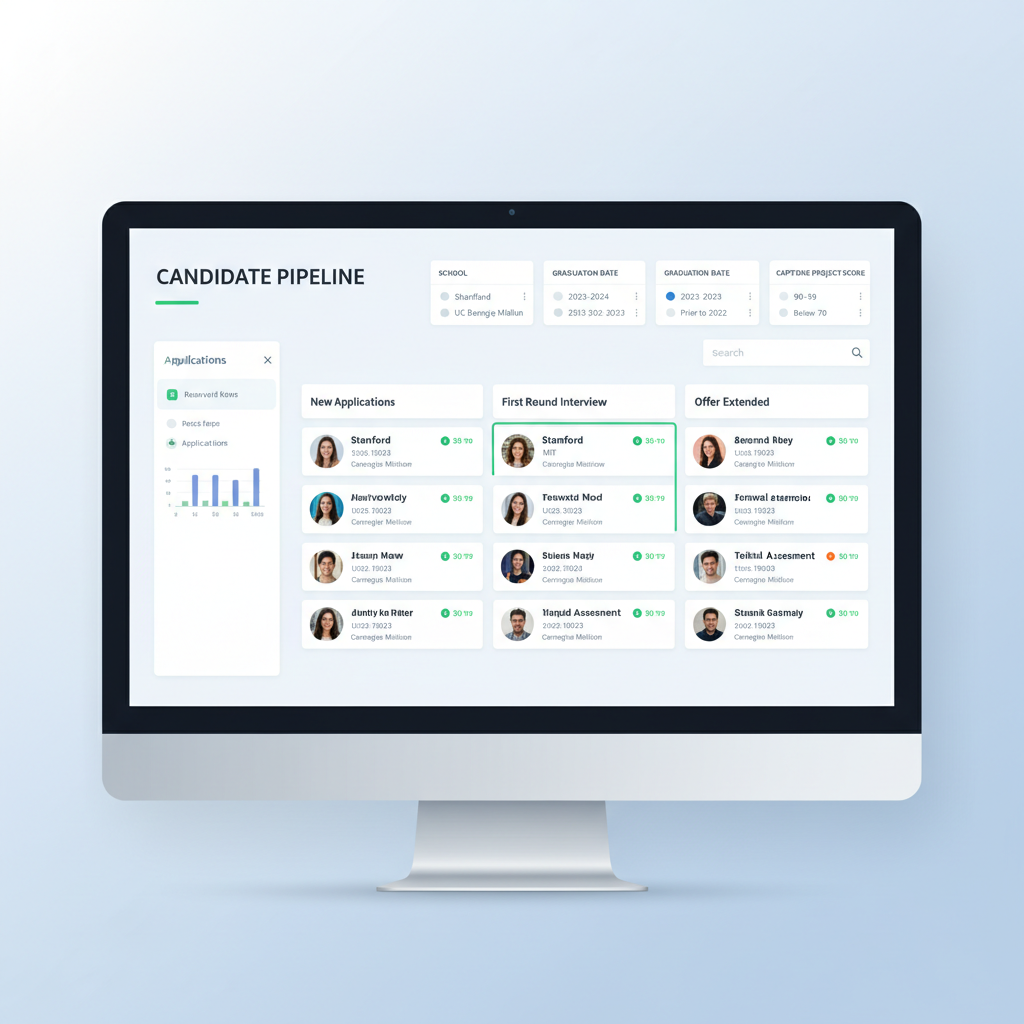
One dashboard. Every campus. Real-time.
Unified school intake
All 32 campus feeds pipe directly into a single ranked pipeline.
Proof-of-work filters
Filter by capstone score, hackathon placement, or lab tenure.
Centralized feedback loop
Interview notes, scores, and decisions logged in one place.
Conversion analytics
See offer acceptance rates broken down by school and recruiter.

Measurable Outcome
−38
Days reduced from first contact to signed offer
Offer acceptance rate over 7 recruiting cycles
91%
Offer acceptance rate (up from 67%)
4.2×
More diverse candidate shortlists
We used to lose candidates between campus and close because nobody owned the handoff. Recruit made the handoff disappear — it just happens.

Marcus Webb
University Relations Manager
Stripe
Early-Career Recruiting Lead · Priya Nair
The Challenge
Hackathon winners were slipping through the cracks.
Stripe's engineering team knew the best new-grad engineers often come from competitive hackathons — but there was no systematic way to find them. The résumé stack didn't surface competition history, and by the time a candidate was flagged, they'd already signed elsewhere.
No filter for hackathon placements or open-source contribution history in ATS
Time-to-first-contact averaging 18 days — fast movers accepted competing offers
Intern-to-return-offer tracking done manually in a quarterly spreadsheet
Platform Workflow
Surface builders before they're discovered.
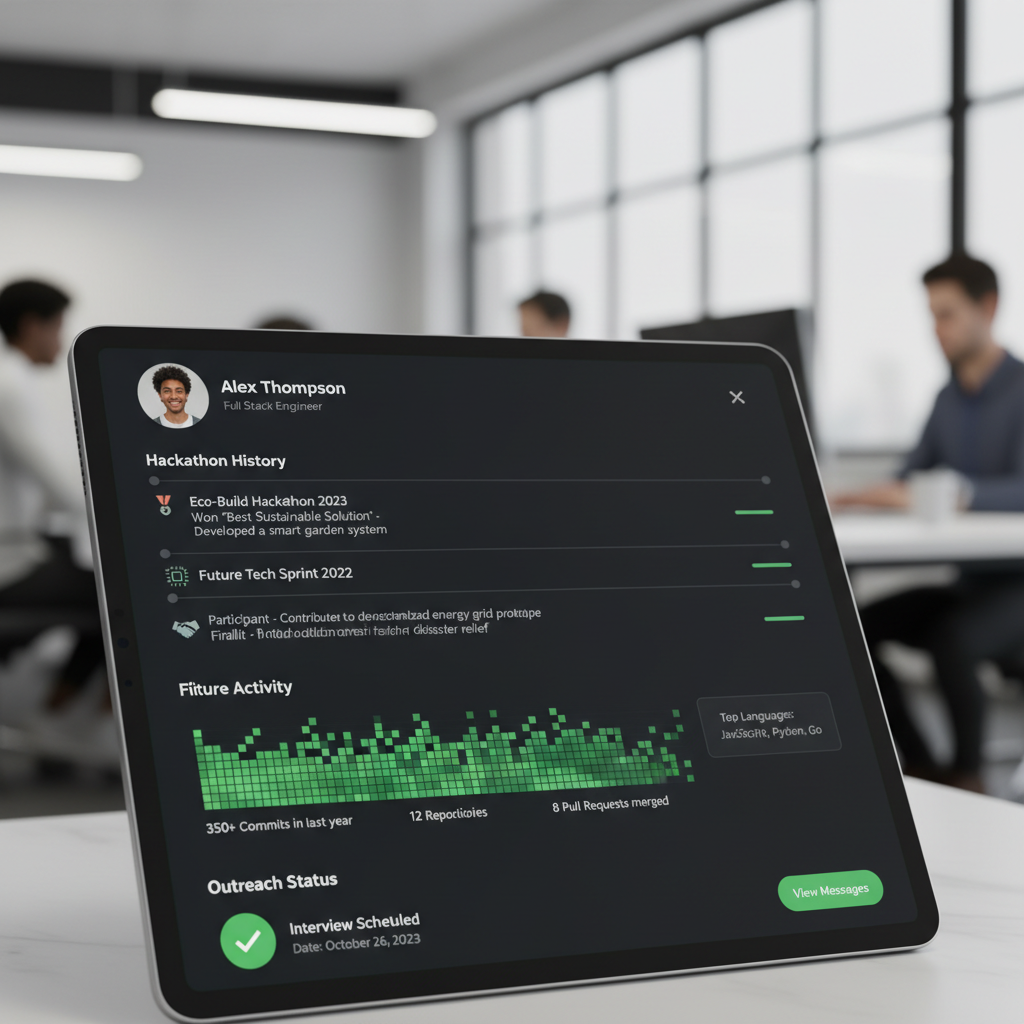
Hackathon signal layer
Recruit indexes 200+ collegiate hackathons and surfaces top finishers.
48-hour outreach window
Alerts fire the moment a target candidate posts graduation intent.
GitHub integration
Link public repos directly to candidate profiles for code review.
Cohort return-offer tracking
Monitor intern performance scores against return-offer decisions.
Measurable Outcome
3.1×
More hackathon-sourced hires vs. prior cycle
Hackathon-sourced candidates per quarter
11 days
Average time-to-first-contact (down from 18)
78%
Intern return-offer rate this cycle
The engineers we want most aren't sitting in résumé databases. They're winning hackathons on Friday night. Recruit finds them by Saturday morning.

Priya Nair
Early-Career Recruiting Lead
JPMorgan Chase
VP, Campus & Early Careers · Danielle Okafor
The Challenge
Diversity goals set in boardrooms, missed in hiring rooms.
JPMorgan's early-careers team had ambitious targets for HBCU and HSI recruiting but no infrastructure to match. Campus visits were concentrated at five schools. The rest were managed by email. Diverse candidates made it to phone screens but dropped off before final rounds.
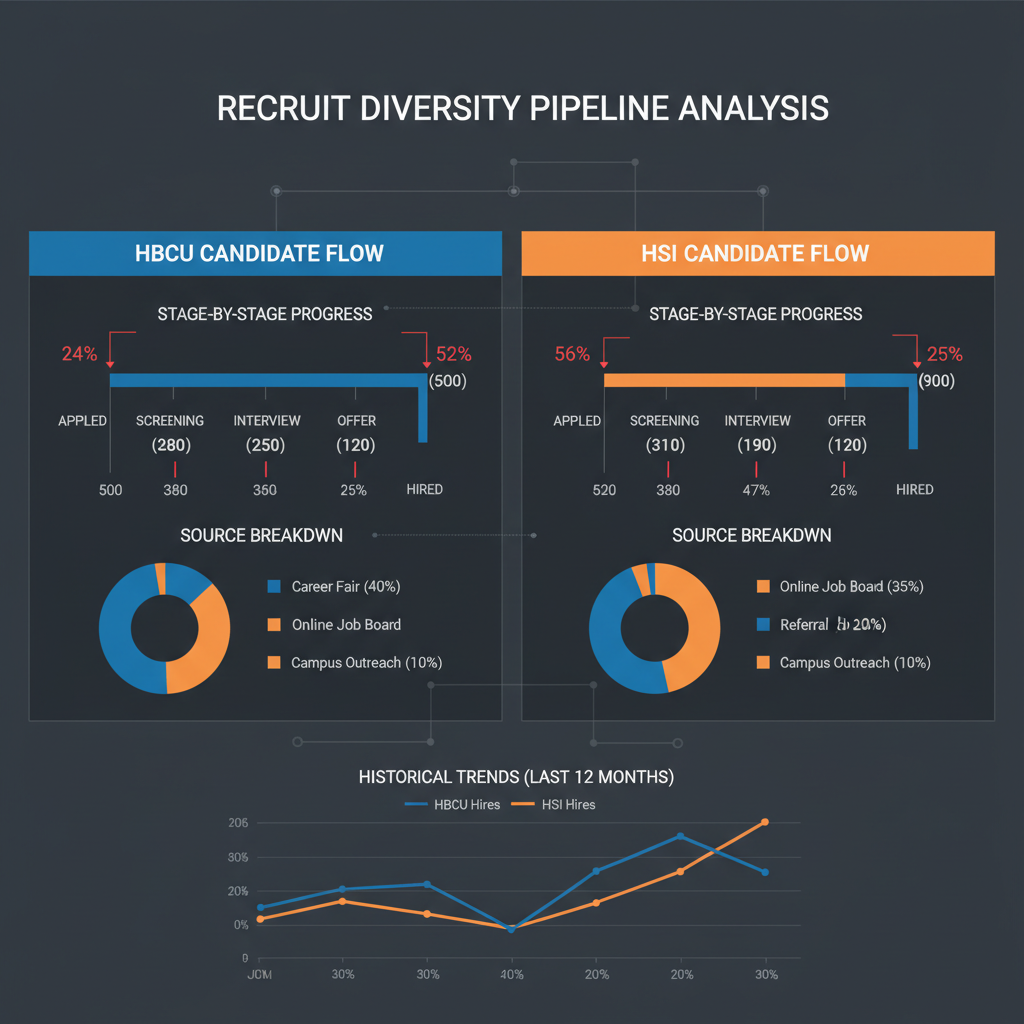
HBCU and HSI pipelines managed separately with no shared tracking
Drop-off rate for underrepresented candidates 2× higher at final-round stage
No data connecting campus event spend to diverse hire outcomes
Platform Workflow
Build the diverse pipeline the data actually shows.
HBCU / HSI school mapping
Recruit pre-maps 105 HBCU and HSI campuses with active career offices.
Drop-off detection
Alerts flag when underrepresented candidates stall at any stage.
Event ROI attribution
Connect every campus fair and info session to downstream hire data.
Inclusive sourcing audit
Monthly report showing sourcing diversity vs. benchmark.
Measurable Outcome
+47%
Increase in underrepresented new-grad hires YoY
Underrepresented new-grad hires per cycle
31 schools
New HBCU/HSI partnerships activated in one cycle
−52%
Final-round drop-off for underrepresented candidates
We had the intent and the budget. What we lacked was the infrastructure to connect campus presence to actual hire data. Recruit built that bridge in one quarter.

Danielle Okafor
VP, Campus & Early Careers
Georgia Tech
Director of Career Services · Dr. Kwame Asante
The Challenge
Placement numbers that couldn't justify the budget.
Georgia Tech's career services office was placing students at strong rates — but the data lived in a post-graduation survey with a 34% response rate. When budget season arrived, the team couldn't prove ROI on employer partnerships or show which programs were actually producing placed graduates.
Post-graduation survey response rate of 34% — placement data was incomplete
No visibility into which employer partnerships produced actual hires vs. just interviews
Career services budget under review with no outcome data to defend it
Platform Workflow
From survey guesswork to real-time placement proof.
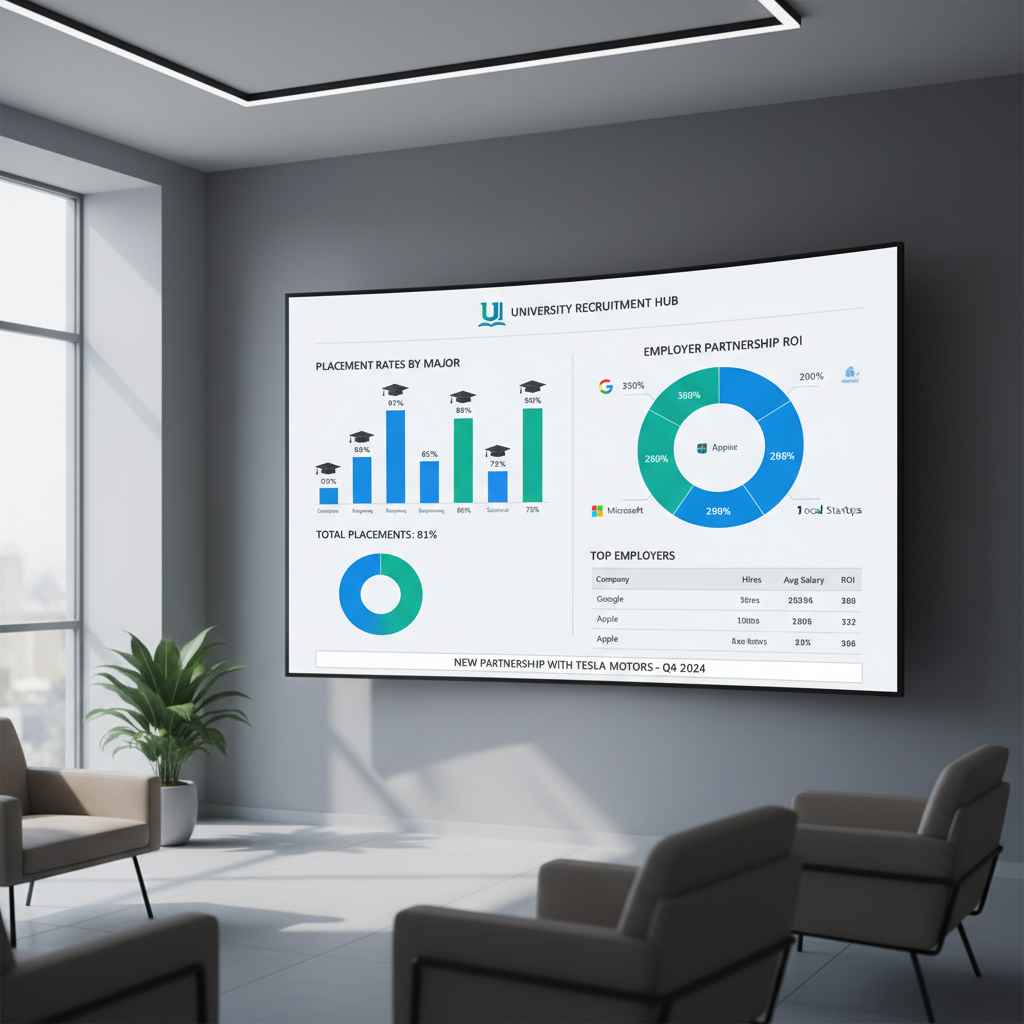
Employer partnership tracking
Every recruiter visit and job post linked to downstream hire outcomes.
Opt-in outcome reporting
Students confirm offers directly in the platform — no survey lag.
Program-level analytics
See placement rates by major, cohort, and employer segment.
Budget justification report
Auto-generated ROI deck for dean and provost review.
Measurable Outcome
89%
Placement data coverage (up from 34% survey response)
Placement data coverage rate over 7 months
+$2.1M
Career services budget retained after review
18 new
Employer partnerships activated using outcome data
The provost wanted numbers. For five years we showed them survey estimates. This year we showed them a live dashboard. The budget conversation lasted twelve minutes.

Dr. Kwame Asante
Director of Career Services
Spelman College
Associate Dean, Career Development · Renée Thibodeau
The Challenge
Top students. Underrepresented on Fortune 500 shortlists.
Spelman graduates were consistently strong — but the college's career office lacked a direct channel to the Fortune 500 university relations teams that were actively seeking diverse talent. Employers claimed they couldn't find HBCU candidates at scale. The candidates were there. The pipeline wasn't.
No direct channel to Fortune 500 university relations managers at scale
Employer outreach managed by individual faculty relationships — not systematic
Students unaware of employer interest until weeks after recruiting windows closed
Platform Workflow
Put Spelman graduates in front of 2,400 recruiters.
Verified institutional profile
Spelman's profile surfaces to employers searching for HBCU pipelines.
Student opt-in matching
Seniors opt in during advising appointments — no extra friction.
Recruiter interest signals
Career office sees which employers viewed and shortlisted students.
Outcome confirmation loop
Placed students confirm offers in-platform, building placement record.
Measurable Outcome
6.4×
More Fortune 500 employer connections than prior academic year
Active Fortune 500 employer connections per semester
94%
Senior opt-in rate via advising integration
+29
New employer partners in first two semesters
Our students were always qualified. What they lacked was visibility in the rooms where hiring decisions get made. Recruit put them in those rooms.

Renée Thibodeau
Associate Dean, Career Development
From target list to signed offer
in four steps.
Build Your Target List
Specify your top schools, graduation timelines, majors, and GPA filters. Recruit surfaces candidates who match — not a generic résumé dump.
Review Proof of Work
Each candidate profile surfaces capstone projects, hackathon placements, lab research, and co-op evaluations — not just a GPA and a club list.
Engage in One Click
Send a personalized outreach, schedule a campus conversation, or drop a candidate directly into your ATS pipeline without leaving the dashboard.
Track Intern-to-Hire Conversion
Close the loop on every cohort. Recruit tracks offer acceptance, onboarding, and return-offer rates so your campus ROI is always visible.